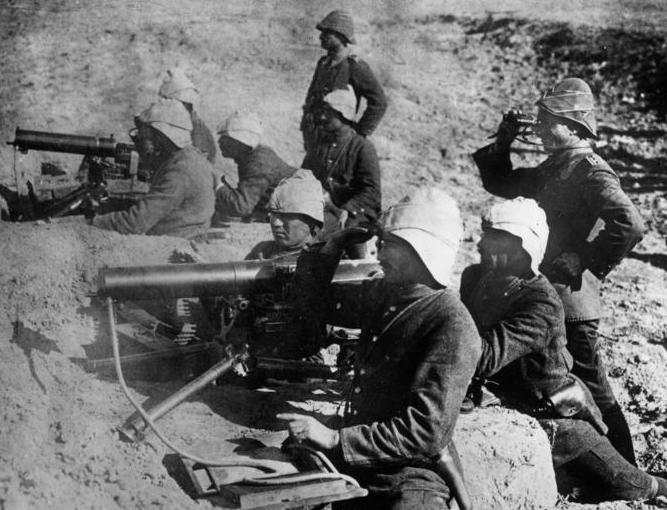
The nations that took part in the Gallipoli Campaign are now all friends. To understand why this was not always the case we need to look back to the days of Empires and politics and the alliances of states and commercial interests that caused a melting pot of greviences, retribution, patriotic visions of grandeur and expansionist policies that brought about two great world wars within just a few years of each other.
Whilst the Gallipoli Gampaign may only have been one small part of the wider devastation of World War I that saw the loss of millions of lives, it was nevertheless of significant importance to Turkey, its future, and the birth of the nation that we know today.

It is important to mention that Turkey regarded the UK as friends and had no interest in becoming embroiled in a war with Britain. However, as the Sarajevo Crisis of 1914 developed Germany offered the Ottomans an alliance against Russia which did not commit them to any military action. War broke out on 30th July 1914 and new naval vessels which were being built in Britain for the Ottoman navy were subsequently requisitioned for the British Navy. Relations between the Ottomans and the British were now strained and to make matters worse Germany offered the Ottoman navy two battle cruisers.
The Ottoman Empire had maintained good relations with the British but increasing influence by Germany and its military training of Turkish forces tipped the bias towards Germany. The Balkan wars of 1912-1913 had left the Ottoman Empire desperately short of funds. Germany, Britain and France offered to assist and although most of the Ottoman cabinet were pro-British Enver Pasha who had served as military attache in Berlin was apposed to the British and preferred to have closer relations with the Germans. From the allied perspective the main interest in Turkey was that it retain its neutrality. If a war were to break out the strategic importance of Turkey would be significant.
International law at the time required the Ottomans to refuse entry to the Dardanelles but by allowing German military ships to travel to Constantinople they confirmed their allegiance to Germany. The British recalled their naval mission from Constantinople over concerns that Turkey was on the brink of entering the war. The Imperial Germannavy took command of the Ottoman navy and closed the Dardanelles on 27th September 1914. The scene was set. With German successes across Europe and beyond the Ottoman government felt confident enough to declare war on Russia.
The Ottomans attacked the Russian port of Odessa on 27th October and sank several Russian ships. The Allies demanded cessation and that the Ottomans expel the Germans. The Ottomans refused and on 31st October 1914 they officially entered the war in support of Germany. Russia then declared war on Turkey on November 2nd. The British left Constantinople and then promptly bombed the defensive forts of Kum Kale and Seddulbahir killing 86 soldiers. Both France and Britain declared war on the Ottomans on 5th November 1914.

From this point it was inevitable that the Dardanelles would come under attack. This would come in April of 1915 and prove to be a bloody conflict that would define Turkey through the death of an empire and the birth of a nation. Britain and France launched an attack that would result in many casualties for both sides and last for 8 months before its cessation without victory for the Allies.
As the Turkish Empire crumbled in defence of the Motherland a national hero was born – Mustafa Kemal, a leader who would take Turkey to Independence and form a Republic. The Gallipolli Campaign is also a milestone in the histories of New Zealand and Australia with 25th April known as Anzac Day for both countries.
Winston Churchill, First Lord of the Admiralty, proposed a naval attack on the Dardanelles after Nicholas of Russia appealed to Britain for assistance against the Ottomans. Following attacks by the British during February 1915, the main attack commenced on 18th March. A total of 18 battleships with support cruisers and destroyers commenced the attack but the British and French ships suffered from mine damage. Both Britain and France used old and obsolete ships for this campaign and they had expected heavy losses so the campaign progressed with French troops landing on the Greek Island of Lemnos in preparation, and a land force of 78,000 was assembled called the MEF and consisting of soldiers from Australia, New Zealand and Britain who would all converge from bases in Egypt.

At best the campaign was ill planned and with little thought given to an unprepared force landing on defended soil. Also the terrain was not favourable to an invasion force and the allied intelligence had not rated the average Turkish soldier very highly, an error that was to prove costly as the campaign unfolded. The Turks were now fighting for their very survival not battling it out in some foreign land attempting to hold territory. This was an entirely different circumstance and environment.
There are so many individual attacks and counter attacks by both sides. There are many tales of heroic deeds by soldiers from all of the nations involved. How sad then that thousands of young men in their prime should be subjected to this massacre of epic proportions on a World War that was pointless and futile and which could have been avoided.

It should be remembered that these brave men gave their lives for their countries and for the cause that all of them respectively believed in and that they were only following the orders of their leaders and fighting for the defence of, or the support of, their respective homelands. How would they have all reacted if they had been able to come to understand the cultures and the personalities of their opposite numbers and sit with them over a meal and discuss what they were all fighting for and what they hoped to have achieved. Alas, war is not like this and such opportunities are rare in battle.
The Turks under Mustafa Kemal proved to be competent and resourceful. They were good fighters and quickly earned the respect of the Allied Forces. With the assistance of the Imperial German Army and Liman von Sanders, a late Allied landing which gave much needed time for preparation and defense plans including the formation of a small Air Force.

The Allies landed at six locations, the most famous of which are Anzac Cove and Helles. In these first few days of battle the battle lines would be formed and for the most part remain throughout the campaign.
At one point, out of ammunition and facing the attackers with nothing but bayonets Mustafa Kemal is famous for saying to his troops, “I do not order you to fight, I order you to die. In the time wich passes until we die, other troops and commanders can come forward and take our places”. Every man of the regiment was either killed or wounded. It is for this reason and out of respect, there is not 57th Regiment in existence in the Turkey army today.


Failure by the Allies to push their advance after the initial attack and the heavy losses incurred by stiff resistance from the Turks and their German allies resulted in a stand off between defence and attack with some well planned and other haphazard attacks by both Turks and the Allies. On one such attack by the Turks on 19th May involved 42,000 Turkish troups efforts to push back 17,000 Australians and New Zealanders who were behind heavy fortifications. Lacking the artillery and ammunition the Turks who had been spotted by British warplanes, lost the element of surprise, and in the ensuing battle they sustained 13,000 casualties. Such were the high numbers of dead that the Allies organised a truce so that the Turkish army could retrieve its dead lying in no man’s land. This and other respectful instances of bravery and compassion by both sides led to an unusual degree of camaraderie between the two armies


In total, the Gallipoli Campaign, which ended on January 9th 1916, resulted in the loss of over 44,000 Allied killed in action with 97,000 wounded. The Turks lost over 87,000 men with over 165,000 wounded. The war, for all its reasons was a failure and a human tragedy. The Allied forces came to see the Turks in a different light. For all the propoganda about the Turks your average Allied soldier had no particular disdain for his enemy and even a healthy respect which is evident from the large amount of dried raisins and fruits that were thrown at the Allies by the Turks and the large reciprocal traffic of tinned food and cigarettes bombarding the Turks by return.
The Gallipoli Campaign came to an end through stalemate, heavy losses and the complication of Bulgaria entering the war on the side of the Central Powers. The evacuation by Allied troops is legendary. Using self firing rifles and explosives the evacuation resulted in very few casualties. The campaign itself was a disaster for all concerned.The Campaign caused the demise of a great Empire but Modern Turkey emerged from this. As a result of this experience Turkey remained cautious and neutral throughout the course of the entire Second World War. A very wise decision indeed.

In 1934 Mustafa Kemal Atatürk wrote a tribute to those killed at Gallipoli:
Those heroes that shed their blood and lost their lives … You are now lying in the soil of a friendly country. Therefore rest in peace. There is no difference between the Johnnies and the Mehmets to us where they lie side by side here in this country of ours … You, the mothers who sent their sons from faraway countries, wipe away your tears; your sons are now lying in our bosom and are in peace. After having lost their lives on this land they have become our sons as well.
What a touching and respectful testamount to a great leader and the founder of a nation. Let this be a message to those that would go to war for dubious reasons. Turkey as a nation maintains a large and effective military deterent against any hostile nation but it can hold its head high as a peaceful nation that does not lightly involve itself in other peoples conflicts or political agendas.




Leave a Reply