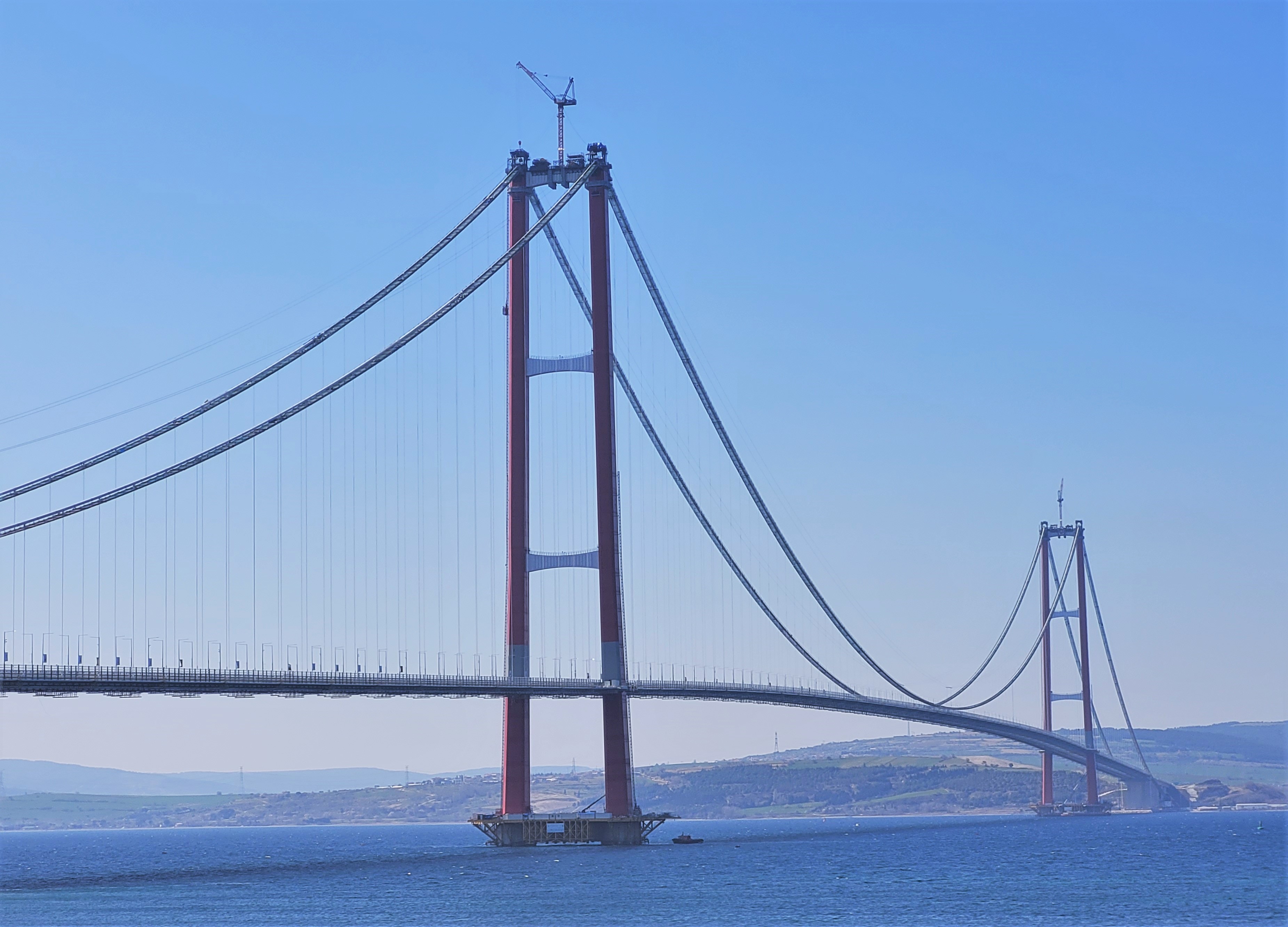
Although the 1915 Çanakkale Bridge is not located directly within the city of Çanakkale itself, its impact on travel and access to the region makes it an important development worth highlighting for visitors to the city. Positioned between Lapseki on the Asian side and Gelibolu on the European side of the Dardanelles, the bridge has transformed transport routes to and from Çanakkale, enhancing both tourism and commerce.
The 1915 Çanakkale Bridge is a landmark achievement in global engineering and national pride. Completed in March 2022, it currently holds the title of the world’s longest suspension bridge by main span, stretching 2,023 metres across the strait. This span symbolically represents the centenary of the Republic of Turkey in 2023. The total length of the bridge, including its approach viaducts, measures over 4.6 kilometres. The twin towers, standing at 318 metres, were designed with further symbolic meaning, marking the date of 18 March 1915, the anniversary of the Gallipoli naval victory during the First World War. Painted in the colours of the Turkish flag, the structure has become an icon of national engineering capability.
Construction of the bridge began in 2017 and was carried out by a consortium of Turkish and South Korean firms, including Limak, Yapı Merkezi, Daelim, and SK Engineering. The total cost of the project is reported to be approximately 2.5 billion euros. It was funded through a public-private partnership model, under which the operating companies have been granted a 12-year concession to manage the bridge before handing it over to the state.
One of the main advantages of the bridge is its effect on travel times. Previously, journeys from Istanbul to Çanakkale involved lengthy detours or waiting for ferries to cross the Dardanelles. Depending on traffic and ferry queues, the trip could take five to seven hours. With the opening of the bridge, that journey can now be completed in roughly three and a half to four hours, bypassing the need for maritime crossings entirely and offering a fast and efficient motorway connection between the Marmara and Aegean regions.
However, the bridge has not been without its challenges. One of the main points of criticism has been the toll fee which is considered high by many Turkish motorists, especially when compared to the cheaper ferry services. As a result, traffic volumes have so far fallen short of expectations, with many drivers still opting for ferry crossings. Due to a contractual guarantee on traffic volume, the state is obligated to pay the operating companies a subsidy when the number of vehicles using the bridge does not meet projected targets, raising concerns about long-term public cost.
Despite these concerns, the bridge offers many positive outcomes. It plays a significant role in boosting logistics, tourism and investment opportunities across the region. As part of a larger motorway project that connects western Anatolia to European Turkey, it enhances transport infrastructure and reduces pressure on ferry terminals. For visitors to Çanakkale, the bridge has opened up faster and more convenient access, encouraging more frequent day trips and weekend stays. It has also become a tourist attraction in its own right, drawing admiration for its scale and design.
In summary, while the 1915 Çanakkale Bridge is not physically located in the city of Çanakkale, its contribution to the region’s accessibility and visibility cannot be overstated. It stands as a symbol of modern Turkish infrastructure, a tribute to the nation’s history, and a catalyst for future economic and touristic growth in the broader Çanakkale area.
Website: https://www.1915canakkale.com/en-us
1915 Çanakkale Köprüsü doğrudan Çanakkale şehir merkezinde yer almamakla birlikte, bölgeye olan ulaşımı ve seyahat imkânlarını büyük ölçüde etkilediği için kente gelen ziyaretçiler açısından önemli bir gelişme olarak öne çıkmaktadır. Asya yakasında Lapseki ile Avrupa yakasında Gelibolu arasında, Çanakkale Boğazı üzerinde konumlanan köprü, Çanakkale’ye gidiş ve geliş güzergâhlarını dönüştürerek hem turizmi hem de ticareti canlandırmıştır.
1915 Çanakkale Köprüsü, küresel mühendisliğin ve ulusal gururun simgesi olan önemli bir yapıttır. Mart 2022’de tamamlanan köprü, 2.023 metrelik ana açıklığıyla dünyanın en uzun asma köprüsü unvanını taşımaktadır. Bu uzunluk, Türkiye Cumhuriyeti’nin 2023 yılındaki 100. kuruluş yıldönümüne sembolik bir gönderme niteliğindedir. Yaklaşım viyadükleriyle birlikte toplam uzunluğu 4,6 kilometrenin üzerindedir. 318 metre yüksekliğindeki çift kuleler de sembolik bir anlam taşımakta; 18 Mart 1915 tarihini, yani Çanakkale Deniz Zaferi’ni simgelemektedir. Türk bayrağının renkleriyle boyanmış olan bu yapı, ulusal mühendislik kapasitesinin bir simgesi hâline gelmiştir.
Köprünün inşaatına 2017 yılında başlanmış ve projeyi Türk ve Güney Koreli firmalardan oluşan bir konsorsiyum üstlenmiştir. Bu firmalar arasında Limak, Yapı Merkezi, Daelim ve SK Engineering yer almaktadır. Projenin toplam maliyetinin yaklaşık 2,5 milyar euro olduğu bildirilmektedir. Köprü, kamu-özel sektör iş birliği modeliyle finanse edilmiş olup, işletmeci firmalara köprüyü 12 yıl boyunca yönetme hakkı verilmiş, ardından köprü devlete devredilecektir.
Köprünün en büyük avantajlarından biri, seyahat süresini önemli ölçüde kısaltmasıdır. Önceden, İstanbul’dan Çanakkale’ye yapılan yolculuklar genellikle uzun dolambaçlı yolları veya feribotla yapılan boğaz geçişlerini gerektiriyordu. Trafik durumuna ve feribot sırasına bağlı olarak bu yolculuk 5 ila 7 saat sürebilmekteydi. Köprünün açılmasıyla birlikte, bu yolculuk yaklaşık üç buçuk ila dört saate indirgenmiş, deniz geçişine olan ihtiyaç ortadan kalkmış ve Marmara ile Ege bölgeleri arasında hızlı ve verimli bir otoyol bağlantısı sağlanmıştır.
Ancak köprü bazı zorluklarla da karşı karşıya kalmıştır. En çok eleştirilen noktalardan biri, birçok Türk sürücünün yüksek bulduğu geçiş ücretidir. Feribotların daha uygun fiyatlı olması nedeniyle birçok sürücü hâlâ feribotları tercih etmektedir. Köprüden beklenen araç geçiş sayısına ulaşılamadığı için, sözleşmeye dayalı trafik garantisi kapsamında devlet, işletmeci firmalara belirli oranlarda ödeme yapmak zorunda kalmakta ve bu durum uzun vadeli kamu maliyeti açısından endişelere yol açmaktadır.
Bu eleştirilere rağmen köprünün sunduğu olumlu katkılar da göz ardı edilemez. Lojistik, turizm ve yatırım fırsatlarını artırarak bölgesel kalkınmaya önemli katkı sağlamaktadır. Batı Anadolu’yu Avrupa yakasına bağlayan daha büyük bir otoyol projesinin parçası olan köprü, ulaşım altyapısını güçlendirmekte ve feribot iskelelerindeki yoğunluğu azaltmaktadır. Çanakkale’ye gelen ziyaretçiler için ulaşım daha hızlı ve konforlu hâle gelmiş, günübirlik ya da hafta sonu seyahatlerini teşvik etmiştir. Aynı zamanda kendi başına bir turistik cazibe merkezi hâline gelmiş, boyutları ve tasarımıyla ziyaretçilerin ilgisini çekmiştir.
Özetle, 1915 Çanakkale Köprüsü her ne kadar Çanakkale şehir merkezinde yer almasa da, bölgenin erişilebilirliği ve görünürlüğüne katkısı büyük önem taşımaktadır. Modern Türk altyapısının bir simgesi, ülke tarihine bir saygı duruşu ve Çanakkale bölgesinde gelecekteki ekonomik ve turistik büyümenin tetikleyicisi olarak değerlendirilmektedir.
Web sitesi: https://www.1915canakkale.com/



Leave a Reply